
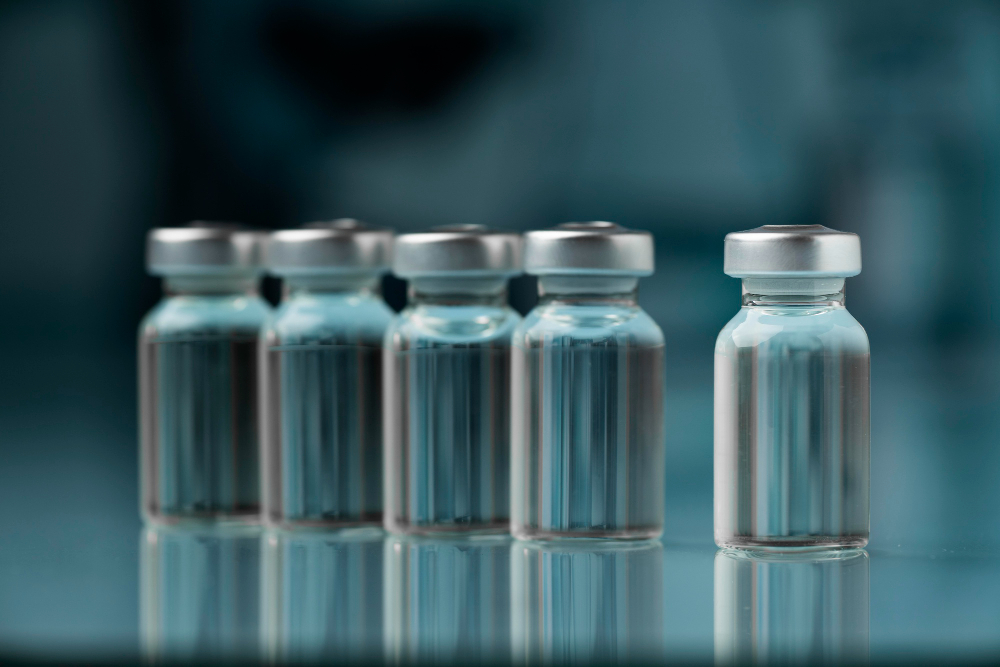
Most peptides are shipped as a dry, freeze-dried powder, not a ready-to-use liquid. Turning that powder into something that can actually be measured and injected is called reconstitution. Getting this step right matters for accuracy and for the stability of the peptide itself. This guide walks through the process, the reasoning behind each step, and how the dosing math actually works, using the same technique described in official prescribing information for approved injectable peptide medicines.
What Does Reconstitution Mean?
Reconstitution simply means adding a liquid to a freeze-dried (lyophilized) powder so it dissolves into a solution that can be measured and injected. The powder form exists because many peptides are more stable dry than they are in liquid form, so manufacturers freeze-dry them for shipping and storage, leaving the final mixing step to be done shortly before use.
What You Will Need
- The peptide vial (freeze-dried powder)
- Bacteriostatic water for injection
- A syringe for mixing (separate from the syringe used for the actual injection, if possible)
- Alcohol swabs
- A sharps disposal container
Why Bacteriostatic Water, Specifically
Bacteriostatic water is not the same as plain sterile water. According to its official FDA drug label, bacteriostatic water contains a small amount of benzyl alcohol, either 0.9% or 1.1% depending on the product, added specifically as a preservative. Source: DailyMed, U.S. National Library of Medicine
That preservative is exactly why bacteriostatic water is used for peptides that will be stored and drawn from multiple times, rather than sterile water, which has no preservative and is intended for one-time use. The same label also notes that bacteriostatic water should not be used in newborns, because of the potential toxicity of benzyl alcohol in that age group, which is a good reminder that this is a real pharmaceutical product with real precautions, not just a generic liquid. Source: DailyMed
Step by Step: How to Reconstitute a Peptide
- Clean your workspace and wash your hands. Reconstitution should be done in a clean area to reduce the chance of contamination.
- Sanitize the rubber stopper on both vials. Wipe the top of the bacteriostatic water vial and the peptide vial with an alcohol swab, and let them air dry for a few seconds.
- Draw the bacteriostatic water into your syringe. Use the amount you have decided on based on the concentration you want (see the math section below).
- Insert the needle into the peptide vial at a slight angle. Let the water run slowly down the inside wall of the vial rather than spraying it directly onto the powder. Adding the liquid slowly and gently reduces unnecessary force on the powder.
- Do not shake the vial. Instead, swirl it gently, or roll it between your palms, until the powder fully dissolves. This is not just a preference. The prescribing information for an FDA-approved injectable peptide product states plainly: “swirl gently; do not shake. Shaking may cause denaturation of the active ingredient.” Source: DailyMed Denaturation means the peptide’s structure gets damaged, which can make it less effective.
- Let it settle for a minute or two. The solution should end up clear, without floating particles or cloudiness. Most peptides dissolve within a few minutes. If you still see undissolved particles, try refrigerating the vial for 15 to 30 minutes and swirling again, rather than shaking or forcing it.
- Label the vial with the date. This helps you track how long it has been since mixing, which matters for the reasons covered in the storage section below.
- Refrigerate the vial.
Example: think of the powder like a sugar cube dropped into tea. If you stir it violently and splash the cup, some sugar sprays out and mixes unevenly. If you stir it gently, it dissolves evenly and nothing is wasted. Peptides are far more delicate than sugar, so the same gentle principle applies, just with more caution.
Working Out the Dose: The Math Behind Reconstitution
This is the part that trips people up the most, so it helps to slow down and see the logic in one clear example.
Reconstitution math comes down to one idea: concentration equals the total amount of peptide divided by the amount of liquid you add. As a simple formula:
Concentration (mcg/mL) = (peptide amount in mg × 1,000) ÷ water added in mL
Example walkthrough:
Suppose you have a 5 mg vial of peptide, and you add 2 mL of bacteriostatic water.
- Step 1: Convert 5 mg to micrograms, since doses are often discussed in mcg. 5 mg equals 5,000 mcg.
- Step 2: Divide the total amount by the liquid volume: 5,000 mcg divided by 2 mL equals 2,500 mcg per mL.
- Step 3: If your target dose is 250 mcg, divide the dose by the concentration: 250 mcg divided by 2,500 mcg per mL equals 0.1 mL.
- Step 4: If you are using a standard U-100 insulin syringe, where the barrel is marked in units and 100 units equals 1 mL, then 0.1 mL equals 10 units on the syringe.
| Step | Calculation | Result |
|---|---|---|
| Convert vial size | 5 mg | 5,000 mcg |
| Find concentration | 5,000 mcg ÷ 2 mL | 2,500 mcg/mL |
| Find dose volume | 250 mcg ÷ 2,500 mcg/mL | 0.1 mL |
| Convert to syringe units | 0.1 mL on a U-100 syringe | 10 units |
The amount of water you choose to add is a personal decision within reason. Adding more water makes the concentration lower, meaning you would need to draw a larger volume for the same dose, which can make small doses easier to measure accurately. Adding less water makes the concentration higher, meaning each dose takes up less space in the syringe.
How to Store a Reconstituted Peptide
Once a peptide has been mixed with water, it behaves differently than the dry powder did. As a general reference point, the FDA-approved labeling for at least one injectable peptide product requires refrigeration at 2°C to 8°C (36°F to 46°F) after mixing. Source: DailyMed
A few general storage principles:
- Keep the reconstituted vial refrigerated, not at room temperature, unless a specific product’s instructions say otherwise
- Protect it from direct light
- Avoid repeated freezing and thawing, since temperature swings can degrade the peptide
- Label the vial with the date it was mixed so you are not guessing later
Be cautious about specific shelf life numbers you see online, such as claims that a peptide is good for exactly 28 days, 4 to 6 weeks, or 3 to 6 months after mixing. Stability varies by the specific peptide, its concentration, and the manufacturer, and there is no single number that applies to every product. When in doubt, use a shorter timeframe rather than a longer one, and discard anything that looks cloudy, discolored, or has visible particles floating in it.
The type of water you use also affects how long a mixed vial should be kept. Bacteriostatic water contains a preservative, which is why it is used for vials meant to be drawn from multiple times over a period of weeks. Plain sterile water has no preservative, so a vial mixed with it should be treated as good for a much shorter window, ideally used the same day, or split into single-use portions and frozen. As an authoritative reference point, USP General Chapter 797, the pharmacy standard that governs sterile compounding, sets a default beyond-use date of only 24 hours under refrigeration for the simplest, lowest-risk category of sterile preparations made without further sterility testing. Source: USP 797 compounding standards summary That standard applies to pharmacy compounding under controlled, clean conditions, but it is a useful, conservative anchor point, and it is noticeably shorter than some of the longer timeframes circulating online for non-preserved solutions.
Common Mistakes to Avoid
- Shaking instead of swirling. As covered above, this risks damaging the peptide’s structure.
- Spraying water directly onto the powder instead of letting it run down the vial wall.
- Using the wrong type of water, such as plain sterile water or tap water, instead of bacteriostatic water, for a vial you plan to use more than once.
- Skipping the date label, which makes it hard to know when a vial should be discarded.
- Guessing at the dosing math instead of working it out step by step, as shown above.
- Reusing syringes or needles, which raises the risk of contaminating the vial and of injury. Use a fresh, sterile syringe each time.
Questions to Ask Your Provider or Pharmacist
- What concentration would you recommend for the specific peptide and dose I am working with?
- What is the actual, confirmed stability window for this specific product once mixed?
- What syringe size and needle gauge is appropriate for this dose?
- What should I do if the solution looks cloudy or discolored?
Frequently Asked Questions
How much bacteriostatic water should I use to reconstitute a peptide?
This depends on the total amount in the vial and the concentration you want to end up with. There is no single universal answer, but the math above shows exactly how to work it out for your specific vial size and target dose.
What size needle or syringe should I use?
A syringe with fine unit markings, such as a standard insulin syringe, is commonly used because it allows for more precise small-volume dosing. The exact needle gauge is usually specified by whoever provided the peptide and depends on the injection method being used.
How long does it take to reconstitute a peptide?
The mixing itself only takes a minute or two once the water is added, though gently swirling until it is fully dissolved may take a little longer for some products.
What does reconstituting a peptide mean?
It means adding a liquid, usually bacteriostatic water, to a freeze-dried peptide powder so it becomes a solution that can be measured and injected.
Can I use sterile water instead of bacteriostatic water?
Sterile water has no preservative and is intended for single use. Bacteriostatic water contains a preservative (benzyl alcohol) specifically so a vial can be used more than once. Source: DailyMed
Why should I not shake the vial?
Shaking can physically damage, or denature, the structure of the peptide, which is why official prescribing information for injectable peptide products specifically instructs swirling instead. Source: DailyMed
Important Health Note
This article is for general educational purposes only and is not medical advice. It is not a recommendation to buy, mix, or use any peptide. Reconstitution and dosing instructions can vary by specific product, and this guide describes general principles rather than instructions for any one peptide. Always follow the specific guidance provided by a licensed healthcare provider or pharmacist, and use sterile technique and proper sharps disposal at every step.
Sources
- Bacteriostatic Water for Injection, official drug label, DailyMed (U.S. National Library of Medicine): https://dailymed.nlm.nih.gov/dailymed/lookup.cfm?setid=87d6e9dc-fe3b-4593-ac9a-d7493d1959c7
- Omnitrope (somatropin) for injection, official prescribing information, DailyMed: https://dailymed.nlm.nih.gov/dailymed/drugInfo.cfm?setid=58d84ffa-4056-4e36-ad67-7bd4aef444a5
- USP General Chapter 797 compounding beyond-use-date standards, summary fact sheet: https://www.mbp.ms.gov/sites/default/files/2023-03/USP_Compounding_BUD_Fact_Sheet.pdf